
Infinite TV: what makes MiniMax H3 Max interesting and what its users argue about
H3 Max makes a five-second video faster than it takes to watch it. Infinite Rick and Morty-style TV, the cost of a never-ending stream, and the debate over closed weights.

MiniMax H3 Max creates short videos with sound faster than they take to watch. People have already built never-ending Rick and Morty-style TV on top of it, and the model itself has sparked a different debate: why an improved version of an open model can't simply be downloaded and run at home.
Interdimensional cable that never ends
Rick and Morty had a TV that picked up shows from other universes. For a viewer it is the perfect absurdity machine: flip the channel and there is another story nobody in their right mind would ever film. Developer Rehan Sheikh turned that idea into a generative video demo: he hooked H3 Max up to a live stream and showed his own interdimensional cable.
In the clip that went around on Reddit, familiar characters sit in front of the TV while viewers discuss what is happening in the chat. The interesting part is not the recognizable faces but the ability to prepare new fragments fast enough to keep the stream going. The video model stops being a vending machine that drops a single clip after a wait and becomes part of a working TV channel.
The reaction in the thread was what you would expect. Some people already wanted to build their own stream, others asked about GPUs and cost. But one flaw needed no benchmark at all: as Gandalfthebran pointed out in the discussion, Morty's voice had turned into Rick's.
That sums up the state of the technology well: the format already works as a spectacle, yet a character can still lose its own voice. Speed doesn't remove such errors — it just gets you both a good result and the next laugh sooner.
Five seconds of video in three seconds — what does that change?
Usually the time it takes to create a video has nothing to do with how long the video runs. You can wait several minutes for a short scene, and for an illustration or an edit that is acceptable. A stream that has to run without stopping poses a different problem: the next piece of video is needed before the previous one ends.
In its announcement on August 27, 2026, fal said that H3 Max generates a five-second clip in under three seconds. Crossing that line is what makes infinite TV interesting as more than a joke. While a viewer watches one fragment, the system can prepare the next.
But "faster than playback" doesn't mean the network continuously paints a world that responds instantly to every line. Short generations still have to be assembled into a show, the next request prepared, the result delivered, and the wait hidden behind a buffer of ready fragments. Keeping characters and events consistent between scenes is a separate problem.
Even fal's own page shows the gap between a catchy slogan and a specific mode. In the measurements published on September 8, a five-second generation at 768p takes 2.46 seconds and a fifteen-second one takes 15.17 seconds. That is model compute time: queueing, request handling and file preparation come on top. The separate H3 Max Turbo version has different numbers, and they don't carry over to the regular Max.
So the promise is best read literally: the model can create some short scenes faster than they run. That is already enough for new ways of working, but it is not a universal guarantee for every generation.
Where Max came from and what fal has to do with it
The name is easy to read as yet another MiniMax release, just made more powerful. In fact, H3 Max was built by fal Research on top of MiniMax H3 with its published weights. MiniMax created the base model; fal fine-tuned it and worked on running it efficiently on its own infrastructure. The MiniMax team endorsed the collaboration in the official announcement.
According to fal, the fine-tuning added new data and focused on two things: prompt adherence and visual quality. At the same time the team optimized the inference system. The developers stress that they didn't want speed at the cost of scenes falling apart.
…an optimization only survived if the resulting model continued to hold its position in our internal quality evaluations.
— the fal team, H3 Max announcement
In the announcement the company names the NVIDIA GB200 NVL72 systems the model was trained and served on. That is a significant part of the story: the result comes from fine-tuning combined with server infrastructure, not from a single magic switch you can flip on a home computer.
That is also where the big speedup numbers come from. fal talks about roughly 35 times the throughput of the official MiniMax H3 endpoint. That is a comparison of specific services, not a promise that every user will get the same gain on any GPU.
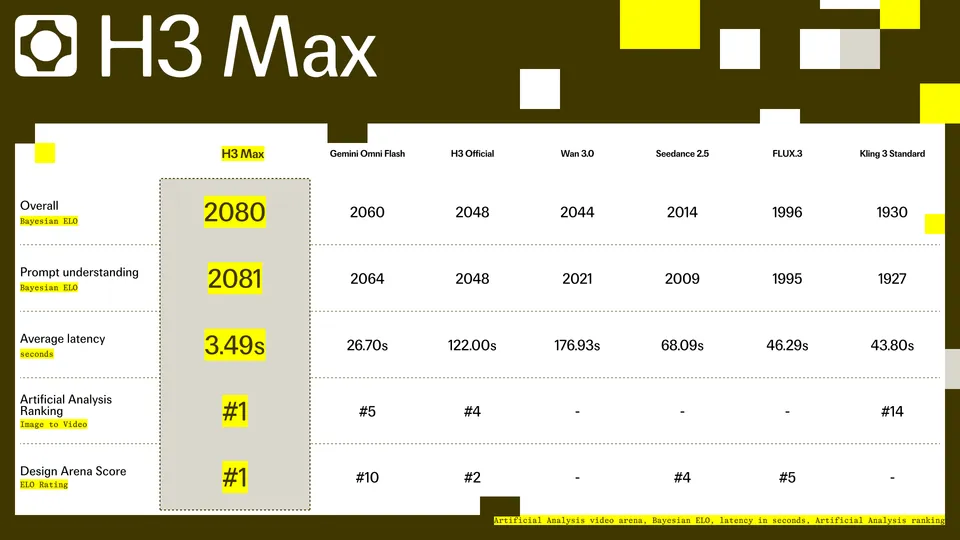
The difference between sources matters too. The viewer preference comparisons run by fal itself are its own research. Design Arena and Artificial Analysis are separate platforms; the announcement cites their image-to-video results. None of these positions means H3 Max handles every task equally well, from a conversation between two people to complex camera moves.
What you can make besides an endless meme
H3 Max takes a text description or a source image, generates short scenes with sound, and lets you set the first and last frames. MiniMax's documentation also describes using images, video and audio as references. Which modes are available depends on the platform: the MiniMax and fal interfaces don't evolve fully in sync.
Sound here is not a separate track you have to add after generation. You can describe speech, music or ambience in the same request. For a quick sketch that is convenient: you get not a silent picture but a scene that already has its sound design. The Morty voice example also shows why having sound and keeping a voice stable are two different achievements.
In practical work, speed helps even without streams. You can try out camera moves, bring an illustration to life, check a transition between two frames, or see whether a short scene idea works at all. Where the first attempt rarely becomes the last, a shorter wait changes the process itself: it is easier to try variations instead of treating every request as the final take.
Still, one impressive showreel won't tell you how much material was thrown away. For a finished clip, what matters is not just five beautiful seconds but repeatability: whether the hero and the setting stay recognizable, whether the action happens, whether the scene can be continued. Demos show what is possible; how many failed attempts a specific task takes is something you have to find out for yourself.
An endless broadcast — with a finite bill
Pieter Levels took a similar idea further with Infinite Slop. In a post on August 29 he described an interactive stream: a viewer writes in the chat, the system generates the next fragment and tries to connect it to the previous one. He openly named an earlier stream by Sheikh and an idea by Marc-Antoine Fontaine as his inspiration.
One detail of this story matters more than the viewer count. Levels explained right away that continuous generation would be expensive and that fal sponsors the project.
It'd be very expensive to run this so @fal very generously sponsors this
— Pieter Levels, Infinite Slop announcement
This example shows a new format and its economics at the same time. With an ordinary video, the generation bill ends at some point. A channel that keeps producing new scenes needs compute for as long as the broadcast runs.
On fal's page the regular H3 Max is priced at $0.08 per second at 768p. A fifteen-second attempt at that rate costs $1.20. That is the price of the footage you get, not a guarantee that it can go straight into an edit: failed takes need generations too. Launch discounts and the cheaper Turbo should be kept apart from the price of the main version.
A sponsored stream proves the format can be built and shown to the public. It doesn't answer how much viewers are willing to pay for an endless channel, or who pays to keep it running after the demo.
"Where do I download it?" — a debate speed doesn't settle
In the discussion of the H3 Max announcement, users quickly moved from first impressions to the question of weights. For part of the community, self-hosting is not a minor detail: people want to run the model locally, control the process and not depend on a third-party platform's pricing. RanklesTheOtter put it bluntly: impressive, but if they can't run it themselves, it is of no use to them.
An open base and the availability of the improved version are not the same thing. In fal's own comparison of H3 and H3 Max, the base model is listed with open weights, while Max has no separate published weights release. Using the service and downloading this exact model for your own hardware are different things.
For a creator who needs a finished result, though, a cloud service solves the opposite problem: no hunting for suitable accelerators and no tuning inference — just get a video through a website or an API. fal sells not only access to the model but also the server system around it. The debate is about who controls the tool and which kind of access counts as enough.
In the end H3 Max is interesting from two sides at once. It shows that faster video generation opens up not just shorter queues but new formats — all the way to a show that viewers invent as it airs. And it is a reminder that an impressive demo doesn't yet make a model available to run locally, voices stable, or continuous video production cheap. Infinite TV can already be built. Figuring out what is actually worth watching on it is still a job for people.